

SELECTED WORK / PRODUCTION
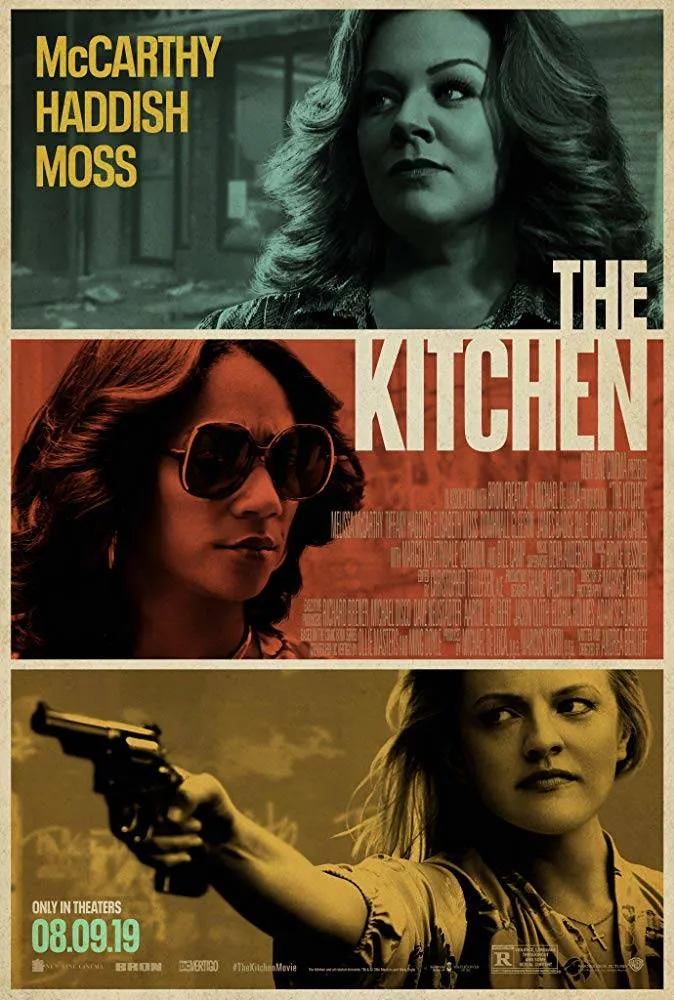
The Kitchen
- Studio
- New Line Cinema
- Released
- August 8, 2019
- SCANable role
- LiDAR/3D Scanning and Modeling
- Director
- Andrea Berloff
The Kitchen is New Line Cinema’s 2019 crime drama starring Melissa McCarthy, Tiffany Haddish, and Elisabeth Moss as Hell’s Kitchen mob wives. Written and directed by Andrea Berloff in her directorial debut and based on the Vertigo comic book miniseries by Ollie Masters and Ming Doyle, the film follows the wives of Irish mobsters who take over organized crime operations in 1970s New York City after the FBI arrests their husbands. Domhnall Gleeson, James Badge Dale, Brian d’Arcy James, Margo Martindale, Common, and Bill Camp co-star. Warner Bros. Pictures released the film in the United States on August 9, 2019.
SCANable performed 3D scans of filming locations, sets, and numerous actors, delivering LiDAR and photogrammetric data for the film’s visual effects and set extension work.
One coordinate space for a scattered shoot
A city-set film is assembled from fragments: a block here, an interior on a stage there, a rooftop that stands in for a different rooftop, all shot weeks apart as permits and daylight allow.
If each of those captures arrives in its own arbitrary space, the VFX team’s first job is not the work — it is deciding what is up, what a unit means, and where the origin sits for every dataset. That reconciliation is slow, error-prone, and entirely avoidable.
Establishing scale and coordinate conventions before the first scan means every location, set, and performer lands in one consistent library. Assets combine without anyone rescaling anything, which is the point of doing set and location scanning as a survey discipline rather than as a series of favours.
Removing the present day
Period work on a real city is mostly subtraction. The street survives; the signage, the parked cars, the air conditioners, the modern glazing, and the light fittings do not belong.
Painting them out is only stable if the geometry behind them is known. A replacement facade projected onto measured surfaces holds through a camera move because it has the real depth of the wall it is covering; the same replacement floated at an assumed distance slides the moment the camera translates.
Measured geometry is what turns a paint-out from a per-frame problem into a solved one.
Populating a street with people who were really there
Period exteriors need crowds that the background artist budget cannot supply. Digital extension of a crowd is standard practice, and its credibility depends on whether the source figures are real people or generic ones.
Scanning cast and background performers in wardrobe produces figures with the proportions, postures, and costume of actual human beings, which is what stops a replicated crowd from reading as a repeating pattern of the same synthetic body.
Captured performers go through retopology, texturing, and render-ready preparation before they populate anything, and the underlying full-body capture is described under digital doubles.
Look through more feature film scanning, or the full service list.