SELECTED WORK / PRODUCTION
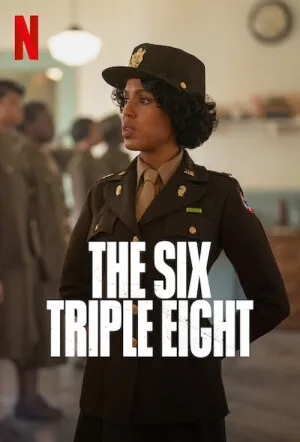
The Six Triple Eight
- Studio
- Netflix
- Released
- December 19, 2024
- SCANable role
- 3D Scanning
- Director
- Tyler Perry
The Six Triple Eight is Tyler Perry’s 2024 Netflix war drama honoring the 6888th Central Postal Directory Battalion, an all-Black, all-female WWII unit. Written and directed by Perry and based on Kevin M. Hymel’s 2019 WWII History magazine article, the film showcases the battalion’s contributions during World War II. It opened in select cinemas on December 6, 2024, ahead of its streaming debut on Netflix on December 20, 2024.
SCANable provided 3D scanning for the production, capturing sets and performers through terrestrial LiDAR and photogrammetric capture to support the film’s visual effects and camera tracking.

Two halves of the same image
Wartime drama is usually built from both halves at once. A real vehicle, real uniforms, and a real interior occupy the foreground; the street beyond, the sky, the damage, and the scale of the operation are completed digitally.
The audience is looking at both in the same image, which means the digital half is being continuously compared against the practical half. Any disagreement in scale, perspective, or ground level registers immediately, even to a viewer who could not articulate what they saw.
Measured geometry from the practical side is what keeps the comparison from being a problem. The extension is derived from the build rather than matched to a photograph of it.
How far one build can be pushed
Period productions rarely construct everything. They construct a portion, then redress and extend it — one hall becomes several, one exterior serves multiple locations.
That strategy only works if the underlying space is described accurately enough to be re-lit, re-dressed, and re-extended in different directions. A single thorough capture of the build supports every variation, whereas a set of location photographs supports the one angle they were taken from. Set and location scanning is what turns a limited build into a flexible one.
Atmospherics need depth to sit in
Smoke, dust, breath, and haze are the elements that make a period exterior feel physically present. They are also volumetric, which means they need to know how far away everything is.
Rendered against a flat plate, atmosphere sits in front of the scene like a filter. Rendered against measured depth, it fills the space between the camera and the far wall, thickens with distance, and occludes correctly.
Point-cloud data supplies that depth directly, which is why environment capture is often requested for shots with no obvious CG element in them at all.
The historical record is public
A film about a real unit is checked against photographs anyone can look up. Uniform detail, equipment, and the look of the working environment are all documented.
That raises the standard for the digital half of the work, and it makes accurate capture of the practical elements more valuable rather than less — the practical side has already been researched, and measuring it carries that research into post-production intact. Performer capture follows the same logic and ships as digital doubles after retopology and render-ready builds.
See more feature film work, or review the services we offer.