

SELECTED WORK / PRODUCTION
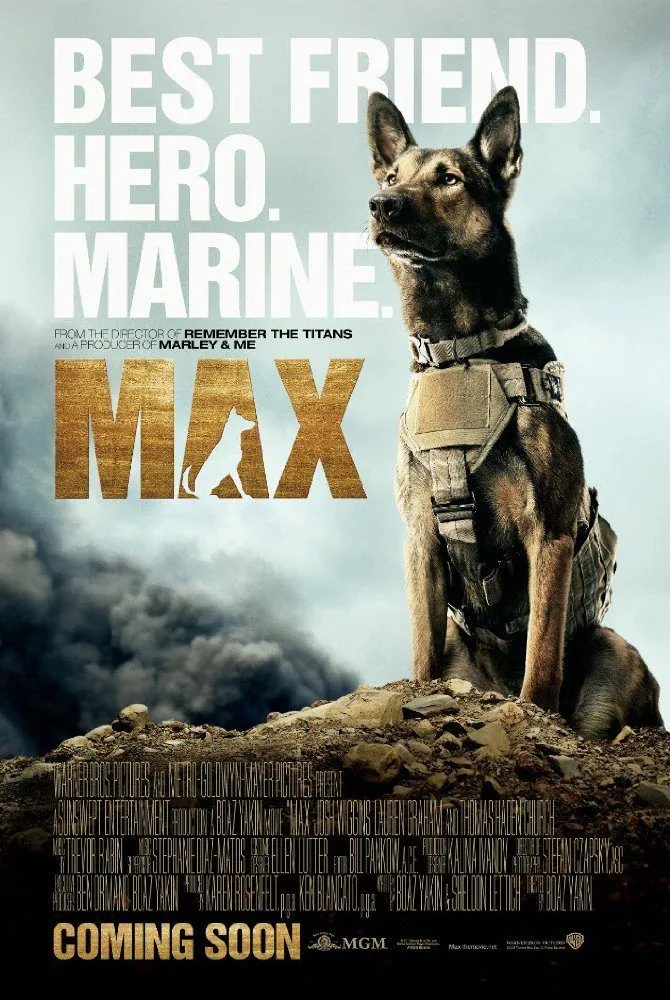
“Max” Movie
- Studio
- Warner Bros. and Metro-Goldwyn-Mayer Pictures
- Released
- June 25, 2015
- SCANable role
- 3D Scanning
- Director
- Boaz Yakin
Max is a 2015 family action adventure from Warner Bros. and MGM about a military dog struggling after losing his Marine handler in Afghanistan. Written and directed by Boaz Yakin from a screenplay co-written with Sheldon Lettich, the film follows Max, a precision-trained military dog who is adopted by handler Kyle Wincott’s family after Kyle is mortally wounded on maneuvers. Kyle’s teenage brother Justin (Josh Wiggins) — with help from Carmen, a tough-talking young teen with a way with dogs — bonds with the traumatized dog as the pair race to unravel what really happened on the front. Lauren Graham and Thomas Haden Church co-star. The film opened nationwide on June 26, 2015.
SCANable provided 3D head and facial scanning of Josh Wiggins for select scenes that required complex facial tracking and VFX supplementation.
A face is a tracking target
Tracking a face is harder than tracking a room. A room is rigid. A face is a deforming surface with very few reliable landmarks, and most of the ones it has move independently of each other.
An accurate head scan gives the solver something rigid to work against — a known surface at true scale that can be fitted to the plate frame by frame. From there the solve can separate the rigid motion of the head from the non-rigid motion of the performance, which is the split almost every downstream operation depends on.
Without measured geometry, both are being estimated at once, and error in one leaks straight into the other.
Supplementation is the invisible half of VFX
Most facial work in a dramatic film is not a digital character. It is augmentation — something added, removed or extended on a real actor’s face, with the performance itself untouched.
Success is defined entirely by the audience never registering it. There is no shot that shows the work off, no moment where the technique is meant to be admired, and no forgiveness at all if it slips for four frames in the middle of a close-up.
Which is why the input matters more here than on spectacle work. A digital double that has to hide inside real coverage is held to a standard a fully CG shot never reaches.
Neutral capture serves shots nobody has designed yet
Scans are usually acquired before the shot list is final, and always before an edit exists.
That argues for capturing neutrally — a clean, undecided baseline with nothing about a particular effect baked into it — because the alternative is data that only works for the shot it was ordered for. Requirements change between the scan and the delivery, every time. A neutral head scan absorbs the change. A purpose-built one has to be recaptured, usually when the actor is no longer available.
Our Mobile CyberSCAN™ Studios capture on the production’s schedule rather than ours, and everything ships after retopology, texturing and render-ready builds.
See more feature film scanning, or explore the full service list.
SELECTED WORK / GALLERY