

SELECTED WORK / PRODUCTION
Call of Duty®: Ghosts “Epic Night Out”
- Studio
- Aero Films
- Released
- November 1, 2013
- SCANable role
- Cyber Scanning/Prop Scanning/LiDAR Set Scanning
- Director
- James Mangold
- VFX vendor
- The Mill
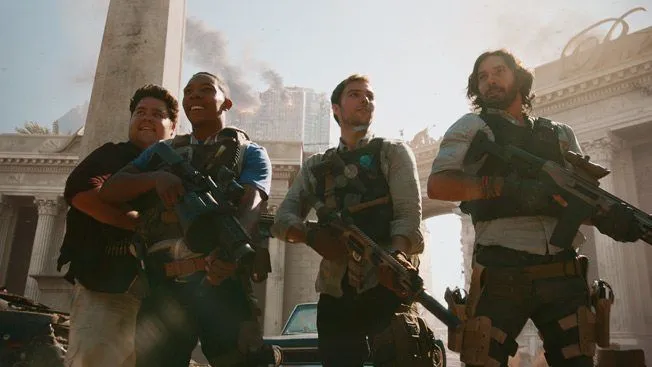
“Epic Night Out” is Activision’s 2013 live-action trailer for Call of Duty: Ghosts, directed by James Mangold with visual effects by The Mill. Living up to the theme “There’s a soldier in all of us,” the teaser from agency 72andSunny follows four buddies battling snipers, tanks and choppers through a besieged Las Vegas, a digital Caracas and even outer space — complete with intense firepower from Megan Fox and a Sinatra soundtrack. Filmed over seven days at locations ranging from the Warner Bros. lot and a blue screen stage to Burbank Airport, the spot required 63 VFX shots that The Mill delivered in just two and a half weeks after only five weeks of prep.
SCANable supported the production with cyber scanning, prop scanning and LiDAR set scanning, capturing the actors’ faces and suits along with the larger sets and hero props. These 3D scans became the digital doubles and photogrammetry assets behind the trailer’s full-CG shots, limb replacement work and vast digital environments.
One asset library across many locations
A shoot that moves between a studio lot, a stage, and a working airport inside a handful of days produces coverage that still has to cut together as one place.
That only holds if every location is captured with the same method, into the same units, with the same conventions for origin and orientation. A digital element built for one setup then transfers to another without a rebuild, and an asset from the first day still fits the layout on the last.
Consistency of capture is worth more than the resolution of any single scan. Set and location scanning is the part that makes a scattered schedule assemble.
Shots the performer cannot be in
Some frames are simply unavailable to a human being — a view from inside an explosion, a fall, a limb doing something a limb does not do.
Those are the shots a digital double exists for, and they are also where a double is most exposed. The audience has just watched the real performer, and the cut back has to be invisible.
Head and body capture in wardrobe gives the vendor a double that already matches the coverage: the same face, the same fit of the costume, the same proportions. Limb replacement and partial-figure work run off the same data, which is why capturing the whole person is worth more than capturing only what a storyboard says is needed. Our Mobile CyberSCAN™ Studios put that capture where the shoot already is.
Hero props are the reference standard
A practical prop is the thing the audience has been shown. Whatever gets built digitally has to agree with it, not the other way around.
Scanning the physical build ends the argument. The digital version carries the same dimensions, the same wear, and the same silhouette, so it can be duplicated, destroyed, or handed to a digital double without a continuity break.
Props are also among the cheapest things on a shoot to capture and the most expensive to reconstruct from photographs later. Everything ships after retopology, UV layout, and texturing.
See more brand and spot work in the portfolio.
SELECTED WORK / GALLERY