

← Back to all work
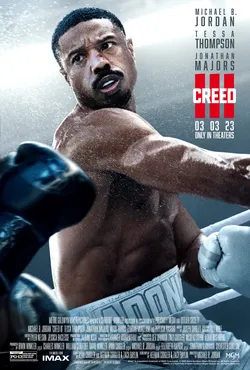
Official poster for Creed III (2023) — MGM sports drama directed by Michael B. Jordan

SELECTED WORK / PRODUCTION

Creed III

Studio
Metro Goldwyn Mayer
Released
March 2, 2023
SCANable role
3D Scanning
Director
Michael B. Jordan
  • Body Scanning
  • CG
  • Feature Film
  • Props
  • Stadiums
  • VFX

Creed III is a 2023 American sports drama directed by and starring Michael B. Jordan in his directorial debut, released by Metro Goldwyn Mayer. Written by Keenan Coogler and Zach Baylin, it is the sequel to Creed II (2018), the third film in the Creed series, and the ninth in the Rocky franchise. Tessa Thompson, Jonathan Majors, Wood Harris, Mila Davis-Kent, Florian Munteanu, and Phylicia Rashad co-star as recently retired champion Adonis Creed comes face-to-face with his childhood friend and former boxing prodigy Damian Anderson.

SCANable was responsible for character, prop, and location scanning on the feature film, capturing the cast and key sets as high-resolution 3D scans. Our photogrammetry data gave the visual effects team an accurate basis for digital doubles and CG environment work.

Filling an arena you cannot fill

A championship fight needs a crowd of twenty thousand. A production can afford background performers in the low hundreds.

The gap is closed digitally, and it only works if the venue itself is geometrically correct. A digital crowd placed into an approximated arena sits at the wrong height, in the wrong seats, at the wrong distance from the ring — and the audience reads that as fake even when every individual figure is well rendered.

Scanning the actual venue produces the seating geometry, the bowl shape, and the sightlines that a crowd system populates. Our set and location scanning is what supplies it.

Why the arena is a different kind of subject

A stadium is not a large room. It is a structure with repeating geometry at a scale where small errors accumulate visibly, and with an interior that a scanner can only see from a limited number of positions.

Capturing it accurately means planning scan positions for coverage of a curved, tiered volume rather than walking a room. Registration has to hold across the whole bowl, because an error that is negligible at one end becomes a visible misalignment at the other.

Boxing is the hardest sport to fake

There is no forgiving distance in a fight scene. The camera is close, the bodies are largely bare, and the audience is watching muscle and skin under hard practical light.

That means digital doubles for a boxing film have to hold up at a scrutiny level most action films never demand. A costume can hide a great deal of imperfect geometry. A pair of trunks cannot.

Capturing performers who are in genuine fight condition, in the physical state the film requires, is the only way to get a double that intercuts with the real coverage.

Simultaneous capture, and the athlete problem

Athletes and performers in that condition still cannot hold perfectly still. Nobody can. A capture method that sweeps or takes multiple passes accumulates drift from breathing and micro-movement, and the drift shows up as soft geometry exactly where muscle definition needs to be crisp.

Every camera in our arrays fires at the same instant, which removes the problem rather than correcting for it downstream. That is the core of cyberscanning as a technique, and our Mobile CyberSCAN™ Studios bring it to the production rather than asking talent to travel.

Props and delivery

Gloves, robes, belts, and gym equipment are all objects the audience sees at close range, and all objects that get duplicated or extended digitally at some point.

Capturing them produces geometry that matches the practical items exactly. Everything ships after retopology, texturing, and render-ready builds — correctly scaled, sensibly UV’d, and named to the production’s convention.

There is more feature film projects to look through, alongside the full service list.