

← Back to all work
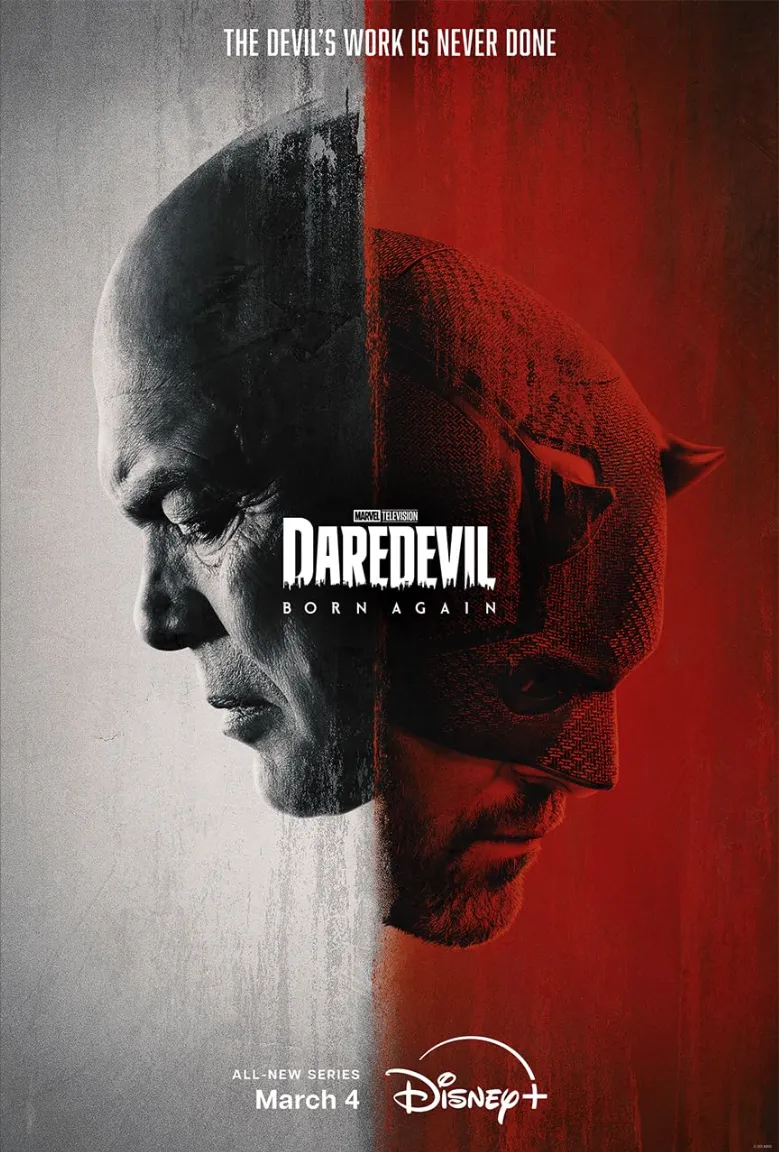
Official poster for Daredevil: Born Again (2025) — Marvel Studios series on Disney+

SELECTED WORK / PRODUCTION

Daredevil: Born Again

Studio
Disney+
Released
March 3, 2025
SCANable role
3D Scanning
Director
Michael Cuesta
  • Backgrounds
  • Body Scanning
  • CG
  • Props
  • Set Extension
  • Television
  • VFX
  • Vehicles

Daredevil: Born Again is a Marvel Studios series for Disney+ that premiered on March 4, 2025, with Charlie Cox returning as Matt Murdock / Daredevil. Created by Matt Corman and Chris Ord, with Dario Scardapane serving as head writer and showrunner after a creative overhaul of the series, it is set in the Marvel Cinematic Universe and is the second series centered on the character following Daredevil (2015–2018). Vincent D’Onofrio, Jon Bernthal, and Margarita Levieva also star. Filming began in New York in early March 2023 — pausing during the Writers Guild of America strike — with Michael Cuesta, Jeffrey Nachmanoff, David Boyd, and the team of Justin Benson and Aaron Moorhead directing, and the series was renewed for a second season.

SCANable was responsible for scanning props, characters, vehicles, and sets across the production, delivering high-resolution 3D scanning and photogrammetry data for digital doubles, set extensions, and seamless VFX integration.

Scanning a show that shoots in a real city

New York is not a backlot. Locations are borrowed for hours, streets are shared with the public, and nothing waits for a scanning crew.

That constraint shapes everything. Capture has to be fast, mobile, and able to work around an active unit — which is why the equipment travels to the production rather than the other way around. A set captured during the window it exists is data the show has forever; a set captured after wrap does not exist at all.

Our set and location scanning is built for that pace.

Four asset types, one library

Props, characters, vehicles, and sets are usually thought of as separate jobs. On a series they are one library, because they end up in the same frame.

The requirement is that all four share a real-world coordinate space and a consistent scale from the moment they are captured. A vehicle scanned at one scale and a set scanned at another will not assemble, and discovering that during a shot is expensive.

Handling all four disciplines under one roof is the practical answer to that. There is nothing to reconcile because nothing diverged.

Rooftop and street-level action

The character’s action language is vertical — rooftops, stairwells, drops between buildings. Those are shots where the camera goes places a camera cannot go, and where the performer does things a performer cannot safely do.

Both are solved with measured geometry and a faithful digital double. The environment gives the shot somewhere real to happen; the double gives it someone real to happen to.

Our arrays fire every camera simultaneously, so there is no drift from a performer breathing or shifting during capture. That is what keeps the double free of the hand cleanup that erodes likeness — see cyberscanning for the full explanation.

Costume capture, in the costume

A scan of a performer out of costume has to be digitally re-dressed, which is expensive and rarely matches. A scan in costume captures the actual thing — how the suit sits on that specific body, where it creases, what the silhouette really is.

That is only practical if the scan happens at the production, between setups, while the performer is already dressed. Our Mobile CyberSCAN™ Studios exist for exactly that workflow.

Set extension and background work

Practical builds stop where the budget stops, usually at the top of frame. Everything above and beyond that is CG, and the join has to be invisible.

Extensions modeled outward from measured point-cloud geometry match at the seam because they share the practical set’s exact dimensions and perspective. Extensions estimated from a plate do not, and the mismatch shows the moment the camera moves.

Everything ships through retopology, texturing, and render-ready builds, scaled and named to the production’s convention.

Additional episodic television work is collected in the portfolio, next to the full service list.