

← Back to all work
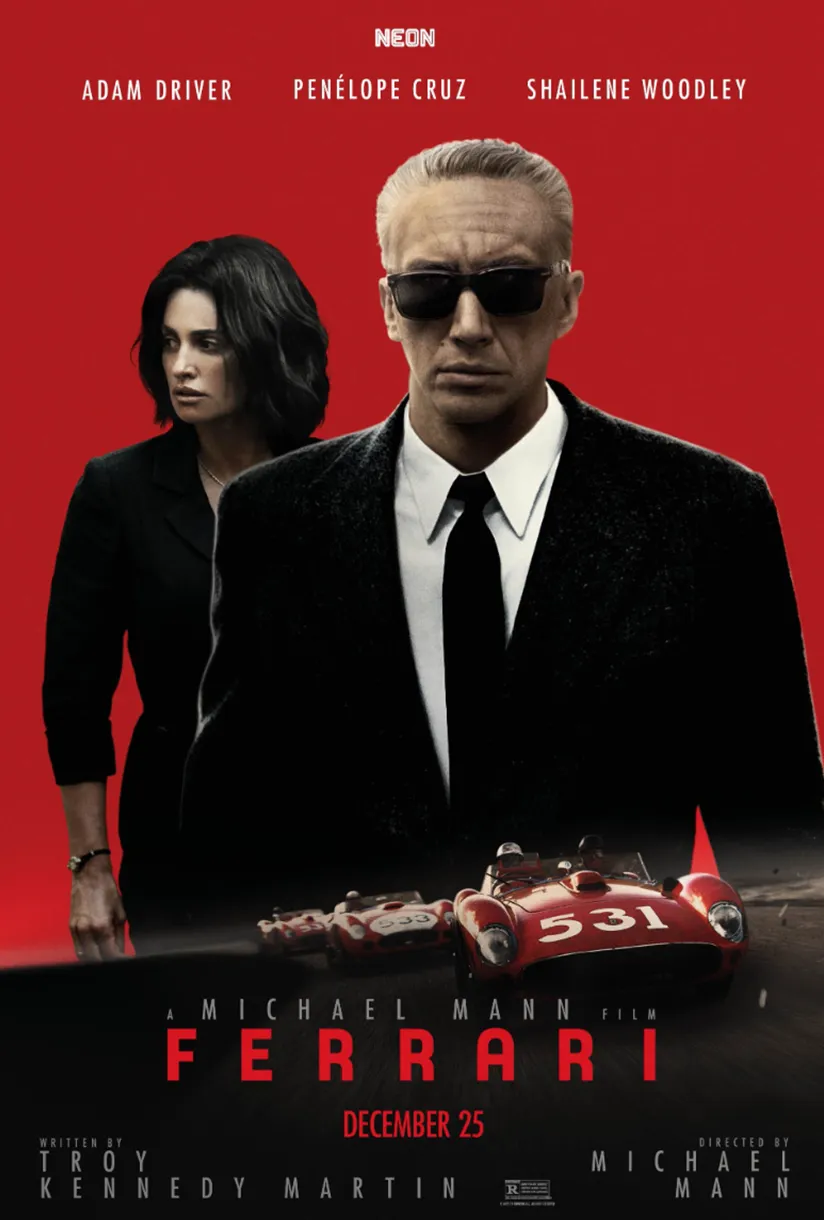
Official poster for Ferrari (2023) — Michael Mann film starring Adam Driver as Enzo Ferrari

SELECTED WORK / PRODUCTION

Ferrari

Studio
Neon Rated
Released
December 24, 2023
SCANable role
3D Scanning
Director
Michael Mann
VFX vendor
Shade VFX
  • Backgrounds
  • Body Scanning
  • Feature Film
  • Props
  • VFX
  • Vehicles

Ferrari is Michael Mann’s 2023 biographical sports drama starring Adam Driver as Enzo Ferrari during the summer of 1957. Written by Troy Kennedy Martin and based on Brock Yates’ 1991 biography Enzo Ferrari: The Man, the Cars, the Races, the Machine, the film follows the personal and professional struggles of the Italian carmaker as Scuderia Ferrari prepares to compete in the 1957 Mille Miglia. Penélope Cruz, Shailene Woodley, Sarah Gadon, Gabriel Leone, Jack O’Connell, and Patrick Dempsey co-star.

SCANable provided 3D scanning for the production in support of visual effects vendor Shade VFX, capturing actors, vehicles, and props as high-resolution photogrammetry data — from digital doubles of the cast to detailed vehicle scans used in the film’s VFX work.

Cars are the hardest thing to scan

Ask anyone who does this work what the difficult subject is and the answer is a car.

Automotive paint is a mirror. Photogrammetry works by finding the same physical feature across overlapping photographs, and a mirrored surface does not have features — it has reflections, which move as the camera moves. Chrome is worse. Glass is worse again.

Solving it is a matter of controlling what the surface is reflecting and how the subject is lit, not simply pointing more cameras at the problem. Done properly, the result is geometry accurate enough to intercut with the real vehicle. Done casually, the result is a mesh full of holes exactly where the audience will be looking.

Period accuracy raises the bar

A film set in 1957 and built around specific, historically real racing machines cannot approximate them. These are cars audiences know, photographed extensively, with proportions that enthusiasts can identify from a silhouette.

Scanning the actual vehicles used in production is the only way to guarantee the digital version matches. Modeling from photographs introduces subtle proportional error, and on a recognizable subject that error becomes the thing people notice.

What VFX does with a vehicle scan

Racing sequences are where practical photography runs out. Real cars cannot be crashed repeatedly, cannot be driven at period speeds on modern roads, and cannot be placed in a shot the camera could not physically occupy.

For those, the scanned vehicle becomes the shot. It is also frequently used less visibly: as a lighting and reflection reference, as a stand-in for set extension work, or as the geometry a practical plate is tracked against.

The full range of that work runs through our modeling and asset build pipeline before it reaches a facility.

Scanning the cast alongside the cars

Motorsport sequences put performers in situations that are unsafe to stage. A driver in an open cockpit at speed, in a period car with no modern safety structure, is a shot that gets finished digitally.

That requires digital doubles accurate enough to intercut with close coverage of the real actor. Our Mobile CyberSCAN™ Studios capture performers in full period wardrobe on the production’s schedule, with every camera firing at the same instant so there is no drift to clean up afterward.

Working to a vendor’s specification

This work was delivered in support of Shade VFX, and that changes the job in a useful way. When the receiving facility is known, capture can be planned to their pipeline — their scale convention, their naming, their preferred topology and UV approach.

Generic delivery forces a vendor to spend time conforming assets before they can use them. Delivery built to their specification does not. On a schedule-constrained show, that difference is measured in days.

The same principle applies to set and location scanning, where the environment data has to align with whatever the vendor is already building against.

See more feature film work, or read about cyberscanning and the full service list.