

SELECTED WORK / PRODUCTION
Megalopolis
- Studio
- Lionsgate Films
- Released
- September 26, 2024
- SCANable role
- 3D Scanning
- Director
- Francis Ford Coppola
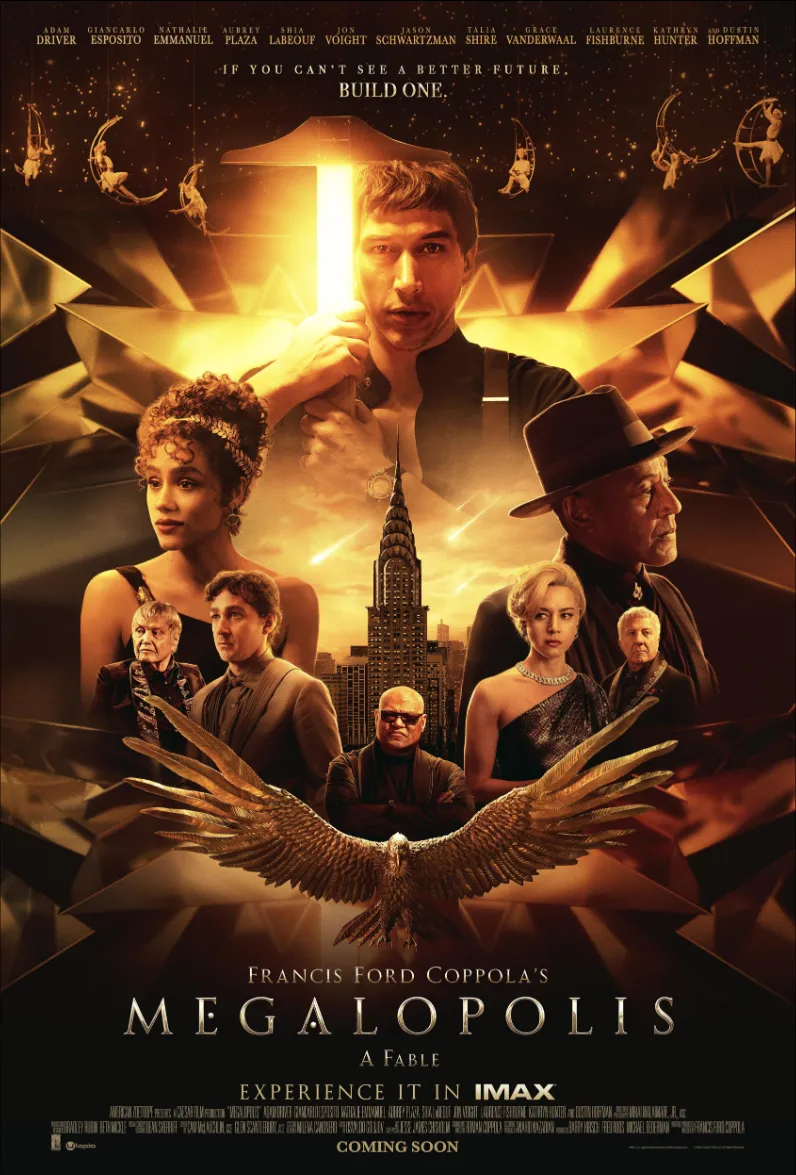
Megalopolis (2024) is Francis Ford Coppola’s epic science fiction drama, written, directed, and produced by Coppola and released by Lionsgate Films. Adam Driver stars as visionary architect Cesar Catilina, who clashes with Giancarlo Esposito’s corrupt Mayor Franklyn Cicero over how to rebuild the metropolis of New Rome after a devastating disaster. The ensemble includes Nathalie Emmanuel, Aubrey Plaza, Shia LaBeouf, Jon Voight, Laurence Fishburne, Talia Shire, Jason Schwartzman, and Dustin Hoffman. Conceived in 1977 and in development for decades, the film was famously self-financed — Coppola sold a portion of his California winery to fund its $120 million budget. Shot in Georgia from November 2022 to March 2023, it premiered in competition for the Palme d’Or at Cannes on May 16, 2024, and was released theatrically on September 27, 2024.
SCANable provided 3D scanning for the production, capturing actors, environments, and props as point-cloud and photogrammetry data to support the film’s visual effects and set extension work.
Architecture is the subject, so the geometry has to be right
A film about an architect rebuilding a city puts buildings at the center of the frame in a way most films do not. The environments are not backdrop — they are what the story is about.
That raises the standard on environment capture considerably. A set extension in an action film needs to survive a fast camera move. A set extension in a film about architecture needs to survive an audience looking at it deliberately, for a long time, while characters discuss it.
LiDAR set and location scanning produces the measured foundation those extensions are built from — real dimensions, real proportions, real relationships between surfaces.
Point cloud as the shared coordinate system
The value of a registered point cloud is not the point cloud itself. It is that everything downstream agrees.
Set extensions build outward from it. Digital environments align to it. Camera solves resolve against it. Props and performers place into it at correct scale. Once measured geometry exists, questions about where something actually was stop being matters of opinion.
Establishing that at capture time is dramatically cheaper than reconciling divergent assets later, particularly on a film distributing work across facilities.
Building a city that never existed
New Rome had to read as a coherent place — one with an internal logic, a consistent scale, and a plausible relationship to the ground people are standing on.
Fully invented environments tend to fail on exactly those points. They look impressive and feel unbuildable. Anchoring digital architecture to scanned real-world geometry gives it a foundation with correct human scale, so an invented skyline sits on a street a person could actually walk down.
Capturing an ensemble on a Georgia shoot
A cast this large, shooting over a months-long schedule, cannot route back to a fixed facility for scanning. Our Mobile CyberSCAN™ Studios travel to the production instead.
Performers scan in the wardrobe and makeup the scene calls for, between setups, with every camera firing at the same instant so there is no drift from breathing or shifting. That is what makes the resulting digital doubles usable without the hand cleanup that erodes likeness — the technique described on our cyberscanning page.
Bespoke objects, kept permanently
Prop capture on a production with this much bespoke design is largely about permanence. Objects built for one film are frequently one-offs; scanning them creates a record that outlasts the build.
All of it — characters, environments, props — moves through in-house retopology, texturing, and render-ready asset builds before delivery, arriving scaled, oriented, and named to the production’s convention.
Related feature film projects sits in the portfolio, and the full service list explains the methods behind it.