

SELECTED WORK / PRODUCTION
The Penguin
- Studio
- HBO
- Released
- September 18, 2024
- SCANable role
- 3D Scanning
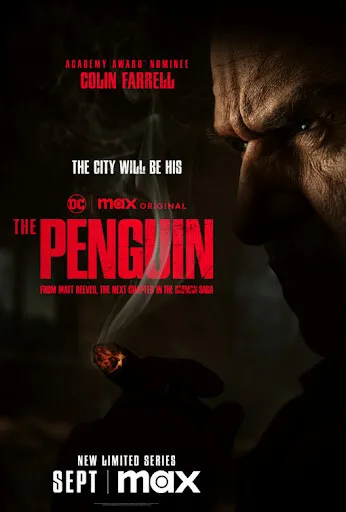
The Penguin is HBO’s 2024 miniseries created by Lauren LeFranc, starring Colin Farrell as the DC villain rising through Gotham City’s criminal underworld. A spin-off from The Batman (2022) produced by DC Studios in association with Warner Bros. Television, the series sees Farrell reprise his film role opposite Cristin Milioti, Rhenzy Feliz, Deirdre O’Connell, Clancy Brown, Carmen Ejogo, Jayme Lawson, Michael Kelly, and Mark Strong, among others. The Batman director Matt Reeves supervised the writing, Craig Zobel directed the first three episodes, and filming took place in New York between March 2023 and February 2024.
SCANable provided 3D scanning for the series, capturing performers and props as high-resolution photogrammetry and point-cloud data to support the show’s visual effects.
Prosthetics change what a scan has to capture
A performance built on extensive facial prosthetics presents a capture problem that a clean face does not. The character’s appearance is a physical construction applied over an actor, and the digital version has to match that construction — not the person underneath it.
That means scanning in full makeup, on the day, in the condition the camera will see. A scan of the performer without prosthetics is useful for almost nothing here; the silhouette, the surface, and the way light sits on it are all products of the applied build.
It also means capture has to fit inside a makeup schedule that is already long. Our Mobile CyberSCAN™ Studios travel to the production precisely so a scan does not cost an extra application.
Continuity across a shooting year
Filming ran roughly a year. Prosthetic makeup is hand-applied and, however skilled the artist, it varies slightly between applications.
A scan taken during that period is a fixed reference point — a measured record of exactly what the character looked like at a known moment. That is useful for VFX work, and it is useful to the makeup department as a continuity check across a long schedule.
Point cloud and photogrammetry answer different questions
Photogrammetric capture excels at surface — fine detail, texture, the specific character of a material. Point-cloud capture excels at space — the volume of a room, the distances between things, the ground truth a scene is built on.
Most productions need both, and they need them registered to each other. Keeping the two in one real-world coordinate space at capture time is what allows a performer, a prop, and a location to assemble in a single shot later without anyone rescaling anything.
The environment side of that runs through our set and location scanning.
Digital doubles for a crime drama
Grounded television generates a different kind of double work than a superhero show. There is less flight and more of the unglamorous category: stunt replacements, coverage in extended environments, and shots where a performer needs to be somewhere the schedule did not allow.
The accuracy requirement is arguably higher. Nothing on screen is asking the audience to accept the impossible, so nothing gets the benefit of the doubt.
Our arrays fire every camera at the same instant, which is what keeps digital double geometry free of the drift that swept capture introduces. See cyberscanning for how that works.
Props and the New York shoot
Props on a series shot practically in a city are frequently in use, in transit, or already committed elsewhere. The scanning window is short and it does not repeat.
Capturing them while they exist produces a permanent digital record — one that survives the object being damaged, replaced, or struck at the end of the shoot. All of it ships through our modeling and asset build work, scaled and named to the show’s convention.
You can browse more episodic television work, or work through the full service list.