

SELECTED WORK / PRODUCTION
Weapons
- Studio
- Warner Bros.
- Released
- August 7, 2025
- SCANable role
- 3D Scanning
- Director
- Zach Cregger
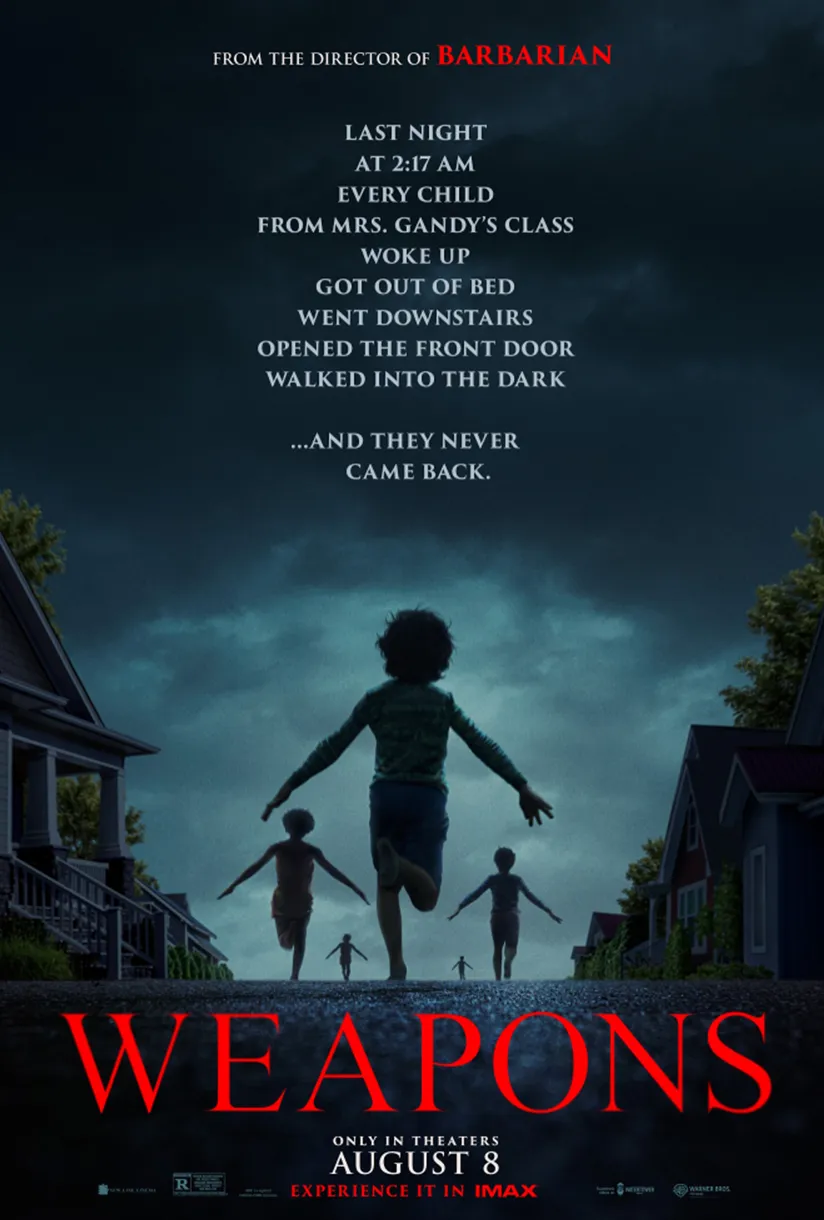
Weapons is Zach Cregger’s 2025 horror epic from Warner Bros. about 17 children from one classroom who vanish simultaneously at 2:17 AM. Written and directed by the filmmaker behind the 2022 hit Barbarian, the film unfolds through multiple interrelated storylines — a structure inspired by Paul Thomas Anderson’s Magnolia — in the fictional town of Maybrook, weaving in supernatural elements including witchcraft. Julia Garner stars as Justine Gandy, the teacher whose class disappears, with Josh Brolin as grieving father Archer Graff and Alden Ehrenreich as Paul, a conflicted local police officer. New Line Cinema secured the rights for $38 million after a competitive bidding war, and strong test screenings prompted Warner Bros. to move the release up from January 2026 to August 8, 2025.
SCANable provided 3D scanning for the production, capturing cast members and props through photogrammetry to support the film’s visual effects.
Horror punishes imperfect effects harder than any other genre
A spectacle film gives its audience permission to enjoy the impossible. Horror does the opposite — it needs the audience unsettled, present, and taking what they see literally.
An effect that reads as an effect breaks that instantly. The moment a viewer thinks “that’s CG,” the fear is gone and it does not come back easily within the same scene.
Which means the underlying capture on a horror film has to be at least as accurate as on a tentpole, despite the effects work being far less visible. The bar is set by what the audience will forgive, and horror audiences forgive nothing.
Photorealism is the whole job
Most of what scanning supports here is not creature work. It is the quieter category: a performer doing something a performer cannot do, a body in a state that cannot be practically staged, an object behaving impossibly.
Those shots live or die on whether the digital element is indistinguishable from the practical photography surrounding it. A digital double built from measured geometry can carry that. One sculpted from reference photography cannot.
Capturing a cast, not a hero
An ensemble structure spreads the requirement. There is no single hero asset to perfect; there are several performers who each need faithful capture because the story rotates through their perspectives.
That is an argument for capturing efficiently on the production’s schedule rather than booking facility time per actor. Our Mobile CyberSCAN™ Studios deploy to the shoot, so a performer steps out of a scene, scans in the wardrobe and makeup the sequence calls for, and steps back in.
Breathing is enough to ruin a capture
Human beings cannot hold perfectly still. They breathe, they settle, they shift.
Capture methods that sweep around a subject or take multiple passes accumulate that motion as drift, which becomes soft or doubled geometry around the eyes and mouth — the features that carry likeness. Repairing it by hand is where a face stops being that person’s face.
A single instantaneous capture eliminates the problem at source. That is what cyberscanning means, and it is why our assets need so little cleanup before a vendor can use them.
Props, and objects that have to behave wrongly
A film built around an inexplicable event needs ordinary objects to do extraordinary things. Ordinary objects are exactly the hardest things to fake, because the audience knows precisely how they should look.
Scanning the practical prop means the digital version that misbehaves is derived from the real one. Nothing about its proportions or surface has been invented.
Delivery runs through in-house retopology, texturing, and render-ready asset builds, scaled and named to the production’s convention. Where a film also needs measured environment data, our set and location scanning covers it.
See more film scanning work, or browse the full service list.
SELECTED WORK / GALLERY